Healthy plants need healthy soil. It seems logical, yet it is one of the most underestimated factors in the garden. Many problems such as poor growth, disease or the constant need for fertilizer are often linked to depleted or unsuitable soils. The good news: You can permanently improve your garden soil with simple steps.
In this post you will discover:
- how to better understand your terrain,
- what methods can you use to improve it specifically,
- and what you should pay attention to in the long term so that your garden remains sustainably fruitful.
1. Understanding soil: What types of soil are there?
Before you improve something, you should know what you are working with. Each garden soil is different and therefore requires different precautions. Here is a brief overview:
Sandy soil
Sandy soils seem loose and difficult to shape. They are well ventilated and warm up quickly in spring. The disadvantage: Water and nutrients can hardly be stored. The plants therefore need to be watered and fertilized more frequently or the soil can be given a targeted boost (see below).
Clayey soil
Clay soils are easy to shape and stick easily to hands. They hold water and nutrients better than sandy soils, but they tend to compact. Without targeted care this can cause water stagnation, lack of air and stubborn crusts in the soil, especially after rain or in summer. If this is the case in your garden, be sure to check out shrubs that are perfect for clay soils.
Soil rich in humus
The ideal case: friable, loose, dark: humus-rich soil stores water and nutrients, but also allows sufficient air to reach the roots. Anyone who has land like this in their garden can consider themselves lucky, but everyone else can get closer to this ideal with a little patience and the right precautions.
Suggestion: A simple kneading test reveals a lot: If the soil is easy to shape, it is more likely to be clay. If it crumbles in your hand, it’s sandy. And if it remains crumbly and has a pleasant smell, it contains a lot of humus.
2. Improve the soil according to the type of soil
Improves sandy soil
A sandy soil benefits above all from humus, that is, from everything that is organic and which is transformed into the soil in the long term. Regular doses of mature compost they help activate soil life and increase the storage capacity of nutrients and water. Also you can The mineral tone incorporate like bentonite. They bind water and act like a buffer. Another effective measure: Mulch with organic material. This protects against evaporation, nourishes soil organisms and ensures that the humus content increases gradually. See below.
Improves clay soil
When it comes to heavy, clay soil, the main thing is to get it looser and airy Neighbor. A combination of is suitable for this purpose coarse organic matter (as compost or mature manure) e Sand (It is important not to use too fine sand. It acts like a sponge and achieves the opposite result).
It is important: do not dig deeply, but loosen with a sow’s tine or fork to preserve the soil structure. Furthermore, plants with deep roots such as radish oil OR Lupinswhich use their roots to loosen and aerate the soil. And: If possible, avoid walking on beds or using footboards to avoid compaction.
Loosen the compacted soil
If the soil absorbs very little water or is very hard, compaction often occurs, for example due to frequent foot traffic or heavy equipment. Mechanical loosening can help here Digging fork or seeding tine. It works best when the soil is slightly moist. The same applies here: don’t dig, just loosen it! Furthermore, the targeted use of rooted plants (such as marigold, marigold or lupine) help improve structure and mobilize soil life.
3. The main methods of soil improvement
Incorporate compost: nutrient source and soil activator in one
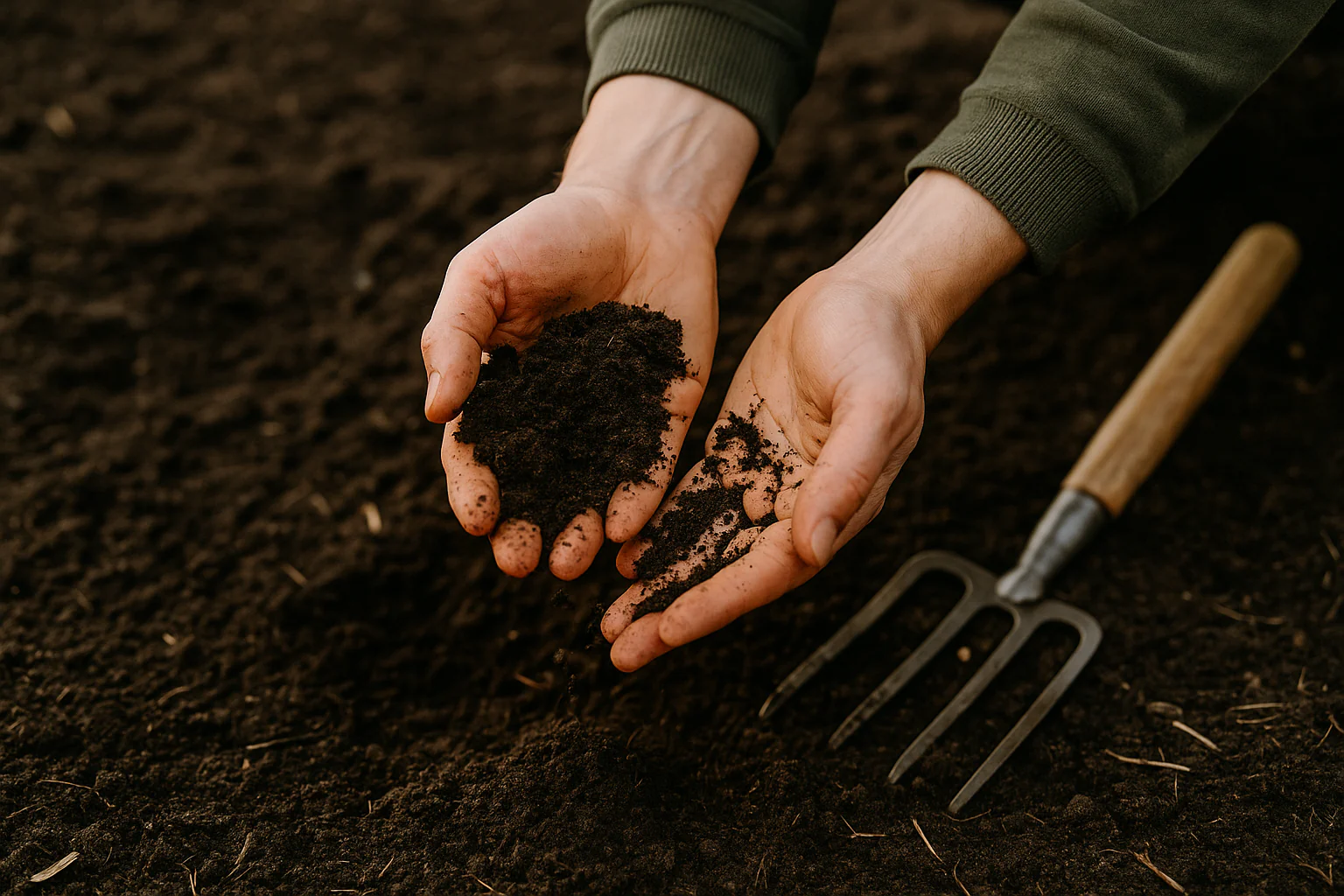
Compost is the classic soil care product. Not only does it provide nutrients, but above all living soil organismsthat permanently improve the soil. It is preferable to work well-ripened compost superficially (3-5 cm deep) in spring or autumn. You can also spread it as mulch between plants.
Here’s how:
- Loosen the soil slightly.
- Distribute the mature compost evenly.
- Work shallowly with a rake or seed tine – do not dig!
Mulching: protect and nourish the soil
Mulching means covering the soil with organic material. This protects against drying out, suppresses weeds and is slowly “used” by soil organisms.
Suitable materials for mulching:
- straw or hay: ideal for loose and ventilated vegetable beds
- Lawn clippings: apply only when dry and thin (max. 2 cm)
- Lab: best crushed and mixed with other materials such as compost
- Wood chips or bark mulch: use only on ornamental flowerbeds, not in the vegetable garden. Make sure the bark mulch binds nitrogen, then prepare the soil again with horn shavings or blood meal before spreading.
Suggestion: Never use fresh bark mulch on vegetable plantings because it removes nitrogen from the soil. However, you can sprinkle a strip of bark mulch around the vegetable bed. If it contains enough tannic acid, it keeps snails away.
Green manure: care for living soil
With green manure, targeted plants are sown that improve the soil, for example through root penetration, nitrogen enrichment or soil protection. The roots loosen the soil, prevent leaching and provide more humus when the plants are later incorporated into the soil.
Suitable species:
- Phacelia: fast growing, deep rooted, bee friendly
- Gelbsenf: loosens heavy soils, suppresses weeds
- Lupine: binds nitrogen, improves sandy soils
- Marigold: Not only does it bloom beautifully, but it can also kill pests in the soil
Here’s how:
- Clear the beds and loosen them superficially.
- Spread the seeds widely and rake them in lightly.
- Allow to grow until flowering, then mow flat and embed or cover.
Biochar / Terra Preta: Preserves nutrients long term
Biochar is particularly porous and can bind large amounts of water and nutrients. In combination with compost, Terra Preta is created, a fertile black earth soil with a particularly stable structure.
Application:
- Activate biochar with compost or primary rock dust
- Works extensively for planting pits or beds
- long-term effect, also ideal for sandy soils
Earthworm humus and bokashi: natural reinforcements for beds
- Wurmhumus: Produced in worm composters, it is particularly valuable and rich in microorganisms.
- Bokashi: Fermented kitchen waste (e.g. Bokashi buckets) is further processed in the soil and brings nutrients and life.
Suggestion: Before spreading, mix the Bokashi with soil or compost and let it sit for about 2 weeks.
Vegetable fertilizer and herbal decoction: pure nature for the soil and plants
One of the oldest and most effective methods of strengthening both plants and soil is homemade manure. They provide nutrients, promote soil life and strengthen plant defenses. And best of all: without chemicals or other equipment.
Nettle manure it’s a true classic. It contains a lot of nitrogen, potassium and iron, essential nutrients for growth. It also has a slightly stimulating and invigorating effect on soil life.
Here’s how to prepare them:
- Coarsely chop about 1 kg of fresh nettles (without flowers and seeds).
- Place in a bucket or barrel and fill with approx. 10 liters of rainwater
- Cover, but do not seal tightly
- Mix every day
- After about 10-14 days the manure is ready (it has a strong smell!)
Application:
- Water diluted in a ratio of 1:10 with water (do not pour on dry ground!)
- Ideal for very fertile plants (tomatoes, pumpkin, etc.)
Field horsetail decoction contains a lot of silica, strengthens plant tissues and can help prevent fungal diseases. Unlike manure, a broth is cooked here:
Here’s how:
- Boil 100 g of fresh field horsetail with 1 liter of water
- Leave to cook for 20-30 minutes
- Leave to cool and filter
Application:
- Dilute with water in a 1:5 ratio
- Spray on leaves or water around plants
4. The right time for floor care
- Spring: Apply compost and mulch, prepare beds
- Summer: Mulch, green manure on harvested areas
- Grass: Loosen the soil, sow green manure, use the leaves as winter protection
Suggestion: Avoid digging, especially in autumn: this destroys soil life. Better: loosen with a sawtooth or a digging fork.
5. Avoid common mistakes
- Too much bark mulch on nutrient-poor soils: nitrogen deficiency
- Peaty soil: loose, but harmful to soil life and the environment
- Permanent compaction walking on it: better to create trampolines or paths
Conclusion: Good soil is the best gardener
You don’t need to be a professional to make your garden soil permanently fertile. You can do this with simple and natural methods such as compost, mulch or green manure improve the soil and actively promote soil life. This means that plants grow healthier, need less fertilizer and you save work and money in the long term.
Happy gardening! 🙂
latest posts published
The best alternatives to cherry laurel and thuja: hedge plants for finches
Heat in the Garden – How to Protect Your Plants from Drought Stress – finch
Evergreen plants in the garden: structure and color
Which one suits your garden? — Tree Finch

Redefine your bedroom with Bernhardt luxury beds
Use climbing roses as privacy screens and green facades in the garden – chaffinch
Best Home Remedies for Your Garden: Chaffinch

Caracole – Elegance, refinement and inspiring design

This is how olives, roses, etc. they survive the finch